



The below blog has information contained within was correct at the time of publication but is subject to change. This is for information purposes only and does not constitute advice.
Buying a house comes with a lot to think about: current mortgage rates, saving enough, finding a lender, and searching for a property that meets your needs.
On top of that, you also need to factor in bond and gilt yields and how they affect current mortgage rates. Many people assume that if the Bank of England base rate stays the same, fixed mortgage rates should stay the same too. If only it were that simple!
While it’s important, especially for tracker and variable-rate mortgages, fixed mortgage rates are much more closely influenced by what’s happening in financial markets, including government bond yields and interest rate swap rates.
Market backdrop in early September 2026
In early September 2026, UK government borrowing costs rose sharply, with the yield on the benchmark 10-year gilt briefly reaching 5.294% on 2 September, its highest level since August 2007.
At the same time, mortgage swap rates rose sharply, creating renewed pressure on lenders to increase the cost of their fixed-rate deals.
This all happened even though the Bank of England base rate remained at 3.75%. So, what exactly are gilt yields, why do mortgage lenders pay so much attention to them, and what could rising yields mean if you’re buying or remortgaging a home?
Key Takeaways
- Gilt yields and swap rates can influence fixed mortgage pricing, even when the Bank of England base rate stays the same.
- SONIA swap rates are generally a more direct indicator of fixed mortgage pricing than gilt yields.
- When market borrowing and hedging costs rise, lenders may increase fixed mortgage rates.
- Gilt yields are affected by factors including inflation expectations, Bank of England policy, government borrowing, economic growth, and global bond markets.
- Tracker mortgages are more closely linked to Bank Rate, while standard variable rates are set by individual lenders.
- Mortgage rates can move before the Bank of England changes the Bank Rate, so it can be worth exploring your options early when buying or remortgaging.
What are bond and gilt yields?
A bond is basically a long-term loan. Governments and companies issue bonds to raise money for things like construction or capital improvements.
Investors buy those bonds, effectively lending money to the issuer in return for interest at a fixed rate, or ‘yield’, and the repayment of their capital when the bond matures. So when you buy a bond, you’re essentially lending money to the company or government that issued it.
When the UK Government issues a bond, it’s usually called a ‘gilt’. The Government might issue a gilt that matures in 5, 10, or 30 years, and investors can then buy and sell these gilts on financial markets.
While not completely risk-free, when the loan has matured, the investor is paid back the nominal/principal value. Government gilts generally carry relatively low credit risk, whereas corporate bonds can carry substantially more risk, so always do your research beforehand.
The ‘gilt yield’ is the yearly profit or return you make on the loan.
A bond’s coupon is the interest payment attached to the bond when it’s issued and is often a fixed rate. However, as the price moves, the effective return available to an investor, or its yield, also changes.
That means when gilt prices fall, yields rise, and when gilt prices rise, yields fall.
If the yield is high, that means investors are demanding a greater return for lending money over that period.
By looking at gilt yields, we can understand the cost of borrowing across the wider UK economy, as they reflect what financial markets expect to happen with inflation, interest rates, economic growth, and government borrowing in the years ahead.
For this reason, bond and gilt yields are important for mortgage lenders to keep track of.
How yields control your fixed mortgage rate
To put it simply, when yields are higher, this means that the government needs to pay more money back to investors who have loaned it money.
This can make new government borrowing more expensive, but it doesn’t directly determine mortgage rates.
There isn’t a direct formula where a 0.25% increase in gilt yields automatically produces a 0.25% increase in mortgage rates. For fixed-rate mortgages, swap rates and lenders’ own funding and hedging costs are generally more important.
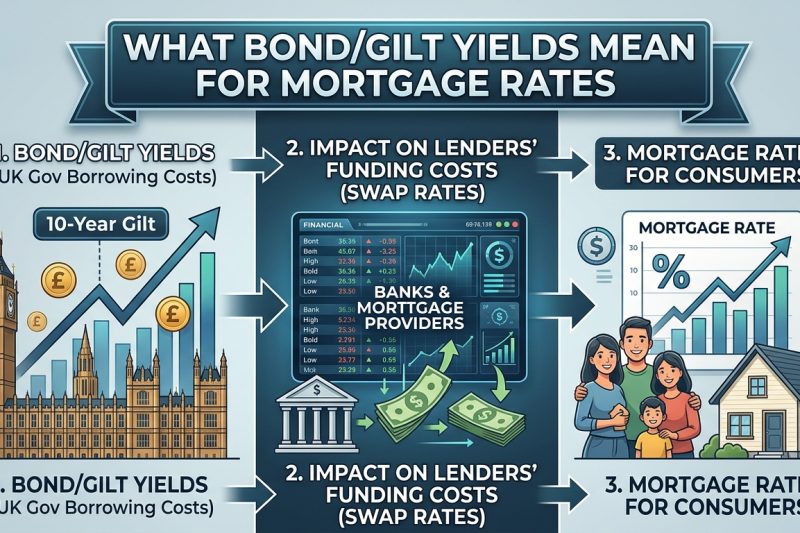
1. Government bond yields set a benchmark for longer-term borrowing costs
Gilts have a widely followed benchmark for the cost of borrowing money in sterling over different periods.
For example, a 2-year gilt offers investors insight into the return available for lending to the UK Government over two years. The same goes for 5- and 10-year gilts.
When gilt yields rise, it usually means the market’s required return on longer-term lending has increased, and since lenders operate in those same financial markets, rises in borrowing costs can make it more expensive for them to offer fixed-rate loans.
2. Swap rates help determine the cost of fixing mortgage lending
If you’re looking at fixed-mortgage rates, SONIA swap rates are generally a more direct indicator of mortgage pricing than gilt yields themselves.
Lenders use swaps to help manage the interest-rate risk of offering fixed deals, particularly over common two- and five-year terms.
If a homeowner wants a 5-year fixed mortgage, they most likely want certainty that payments won’t change over that period. However, the lender has its own funding costs and interest-rate risk to manage over that period, so an interest swap lets lenders manage that risk.
Gilt yields and swap rates tend to move up and down together as they’re influenced by the same things: expected Bank of England policy, inflation, and economic conditions. However, gilt yields can also be affected by factors such as government borrowing and bond supply.
3. Lenders price their fixed-rate mortgages
Lenders have a better insight into what they can lend to borrowers once they understand their funding and hedging costs. Here’s a simple way to look at it:
Market funding and swap costs + lender costs and risk + lender margin = mortgage rate offered to the customer.
Besides the swap rate, lenders will also need to factor in:
- Credit risk
- Operating costs
- Competition with other lenders
- Regulatory and capital requirements
- Their desire for new mortgage business
- The amount of funding they currently have available
Why do fixed mortgage rates and base rates diverge?
If you don’t understand much about mortgages and pricing, this part can be confusing.
Essentially, the Bank of England base rate is today’s interest rate, whereas fixed mortgage rates are partly based on what financial markets expect interest rates and inflation to do in the future.
So the two can move in completely different directions. If we look at what happened in early September 2026, Bank Rate remained at 3.75%, yet bond yields and swap rates rose as markets became more concerned about inflation and future interest rates.
As a result, lenders faced more pressure to raise fixed mortgage rates without any change to Bank Rate. The reverse can also happen; if markets expect inflation and interest rates to fall, swap rates may decrease before the Bank of England cuts the Bank Rate.
Key factors that cause bond yields to rise or fall
Gilt yields can move for many reasons and, more often than not, very quickly.
Inflation
Investors lending money for several years want to know that the money they receive back will retain its value.
Investors may demand a larger return for holding government debt if markets anticipate higher inflation for a longer period, leading to a rise in yields and a decrease in bond prices.
Bank of England interest rate expectations
Economic data on inflation, wages, employment, and growth can move gilt and swap rates before the Monetary Policy Committee changes the bank rate.
That’s why mortgage rates can move several weeks or months ahead of a Bank of England decision.
Government borrowing
The government regularly issues gilts to fund borrowing.
If investors worry about the amount of debt being issued or believe they need a higher return to absorb the extra supply, yields can rise.
Economic growth
Stronger-than-expected economic growth can push yields higher if investors believe it’ll contribute to inflation and prevent the Bank of England from reducing interest rates.
On the other hand, weak economic data can have the opposite effect if markets begin expecting lower rates.
Global bond markets
Movements in US Treasury bonds, European government bonds and other major global debt markets can influence UK yields.
In fact, September 2026’s rise in UK borrowing costs was partly linked to a wider global bond sell-off.
Geopolitical events and energy prices
As noted above, global events can also affect inflation expectations.
For instance, rising oil and gas prices may raise anticipated costs for production, transportation, and domestic energy. Expectations for Bank of England policy may shift if markets think this could lead to UK inflation, causing bond and swap rates to move quickly.
How to time your mortgage deal in a volatile yield environment
All of this is to say it’s important that you or your mortgage advisor factor in all of the things we’ve discussed above to help you secure the best mortgage deal possible.
Since you won’t always be able to predict what’s happening in the market next, it’s better to understand your options early. Start looking at remortgage options several months before your fixed mortgage deal ends.
If you are buying, remember that waiting for rates to fall can be risky, as rising swap rates may cause lenders to withdraw or reprice deals. Also look beyond the headline rate, as fees, your deposit or loan-to-value, mortgage term, and personal circumstances can all affect the overall cost.
Yes, gilt and swap rates are useful indicators, but they shouldn’t be the only thing you focus on when deciding when to apply for a mortgage.
FAQ’s
- Do bond/gilt yields affect tracker or variable mortgages?
- Where can I monitor gilt/bond yields to predict mortgage movements?
Yes, but not in the same way that they affect fixed mortgages.
Tracker mortgages usually move in line with the Bank of England base rate, while a lender’s standard variable rate (SVR) is set by the lender and can be influenced by Bank Rate and its own funding costs.
Gilt and swap rates are therefore more useful for understanding fixed mortgage pricing than tracker or variable rates.
You can follow UK gilt yields through sources such as the London Stock Exchange, Bank of England, and major financial news providers.
For fixed mortgages, two- and five-year SONIA swap rates can often better indicate pricing pressure.
Neither gilt nor swap rates can predict exactly what lenders will do, so use them as a guide rather than a guarantee.
How we can find the best mortgage rate for you
Working with a mortgage broker can make it easier to understand your options without tracking the market yourself. At GMS Ltd, our advisers can compare mortgages from a wide range of lenders and help find a deal suited to your circumstances.
We’ll explain the process from start to finish and look beyond the headline interest rate, considering fees, eligibility, and the overall cost of the mortgage, to help you find the best deal.
Speak to one of our advisors today on 0151 230 0909 or leave us an enquiry and we’ll get back to you as soon as possible.